The images here are not actual drugs. They’re harmless compounds with colouring, arranged to show what the real thing looks like at each stage.
Nobody has ever been talked out of using drugs by a pamphlet. Fifty years of “just say no” reduced exactly nothing except the credibility of the people saying it. So I’ll skip that part.
You’re going to use. Fine. Then at least don’t use a product that some guy cooked in a shed and couldn’t be bothered to wash.
I’m not writing this from a position of moral high ground. I’ve been on the wrong side of all of this, and the part that still annoys me is how much of the damage had nothing to do with the drug. It was the garbage that came with it, and nobody ever mentioned that you could just remove some of it.
This guide will not make amphetamine safe. Amphetamine is not safe. It raises your blood pressure, wrecks your sleep, and has a well-documented talent for turning functional people into people who used to be functional. What it will do is delete one specific category of harm: the leftover reaction junk you are currently paying for by weight and inhaling for free.
One thing before anything else. Cleaning your product makes it stronger per milligram. If you wash your speed and keep using your usual scoop, you just doubled your dose while feeling responsible about it. That’s section 2. Read it before you touch acetone.
1. What’s actually in the bag#
What it’s supposed to look like#
Clean amphetamine sulfate is white, odourless, and free-flowing. No smell. Not “a mild smell.” None. It isn’t yellow, it isn’t damp, and it doesn’t arrive as a rock you have to attack with a bank card.
If yours does, congratulations: you bought a chemistry experiment that somebody abandoned halfway through workup.
What’s actually in it#
Most European amphetamine comes off the Leuckart route. It’s cheap, forgiving, and tolerates an operator who doesn’t really understand what he’s doing, which is precisely why it dominates. It also leaves a consistent set of residues, which is how forensic labs fingerprint batches back to the kitchen they came from.
Your bag usually holds four things:
- Amphetamine sulfate. The bit you paid for.
- Synthesis byproducts. Chemically related garbage from the reaction. This is the genuinely toxic fraction and the reason this page exists.
- Residual solvents and acid. From a workup performed with all the diligence of a man who wanted to go to bed.
- Cutting agents. Added later, by somebody else, purely to make it heavier.
Street purity across a lot of Europe sits somewhere in the 5–20% range. On a bad day nine-tenths of what you weighed out isn’t the drug. You already have extensive experience consuming inert powder. This just helps you find out how much.
Reading it with your face#
Your nose and eyes are free and always with you, which puts them ahead of whatever most people are currently using, namely hope.
| What you observe | What it is | What it means |
|---|---|---|
| Yellow, cream, or orange | Oxidised residues, ketone leftovers, bad workup | Made carelessly. High byproduct load. |
| Grey or brown | Overcooked reaction or contamination | Made carelessly and badly. |
| Fishy / ammonia smell | Residual amines | The classic tell. Somebody stopped purifying early. |
| Solvent / nail-polish / thinner smell | Toluene, ethyl acetate, acetone that never left | It was never dried. You’re inhaling solvent. |
| Vinegar smell | Acetic-family residues | Same story. |
| Sticky, damp, or cemented into rocks | Excess residual sulfuric acid, which is hygroscopic and pulls water out of the air | Also makes weighing meaningless, which matters more than it sounds. |
| Burns far more than it should | Residual acid and caustic byproducts | That is not “strong gear.” That’s a chemical burn. |
| Oily or greasy-looking | Possible freebase content | Behaves completely differently, dissolves in acetone, and breaks this guide’s arithmetic. |
The junk, by name#
You don’t need a chemistry degree. You do need the names, so you can read a drug-checking report without nodding along blankly.
- N-formylamphetamine: the headline Leuckart impurity, left behind when the final step isn’t finished. Labs use it to identify batches. Its presence is a direct statement about how much care went into your product.
- DPIA (di-(β-phenylisopropyl)amine): a secondary amine byproduct with a genuinely nasty toxicological reputation. This is the one you want gone.
- 4-methyl-5-phenylpyrimidine: another route marker.
- Residual phenylacetone-family ketones: the yellow, and a good chunk of the smell.
- Assorted benzyl and dibenzyl amine derivatives: a whole family of nothing-good.
- Residual sulfuric acid: why bad product is sticky, harsh, and clumps into rocks.
There are no synthesis instructions on this page and there never will be. This section exists so you can recognise contaminated product, not make it. If you want the actual chemistry, the forensic impurity-profiling literature is public, peer-reviewed, and considerably better than a forum where the top comment is “trust me bro.”
The cuts#
| Cut | Why it’s there | Acetone-soluble? | The problem |
|---|---|---|---|
| Caffeine | Cheap, bitter, fakes a “kick” | Yes | Stacks cardiovascular load, worsens anxiety and comedown |
| Creatine | White, cheap, powdery | No | Inert. Just weight. |
| Lactose / glucose / mannitol | White, cheap, dissolves in water | Mostly no | Inert. Mannitol will send you to the toilet in quantity. |
| MSM | Recrystallises into convincing shards | Yes | Mostly inert |
| Paracetamol | Cheap, bitter, white | Yes | Liver damage in quantity, especially with alcohol |
| Other stimulants (cathinones etc.) | Substitution | Varies | The actually dangerous one. Washing won’t remove it, it’ll concentrate it. |
Notice the pattern. The wash removes soluble filler and byproducts. It does not remove a second drug that behaves like your drug. That’s what reagents and labs are for.
2. The purity paradox: read this one#
This is the section everyone scrolls past, and the one that will actually hurt you.
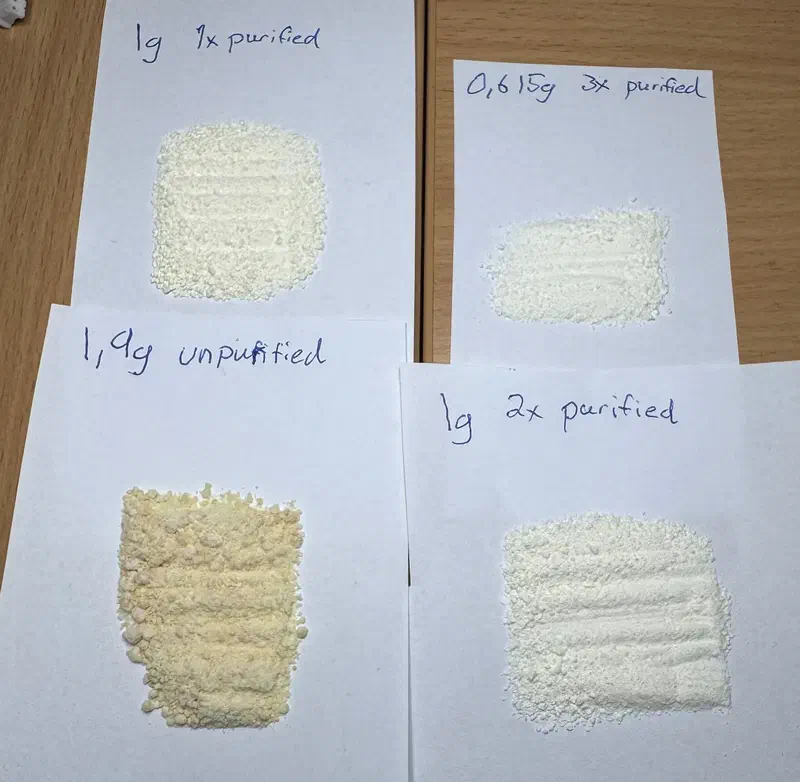
Same material, four stages. Bottom left is what came out of the bag: yellow, lumpy, 1.9 g of it. Top right is the same stuff after three washes: white, fine, 0.615 g. The colour is the satisfying part. The numbers are the part that can kill you.
1.9 g of raw product came out as 1.0 g. Half the mass was junk. Run it three times and you’re at 0.615 g.
Now the arithmetic nobody does:
Your usual dose was 100 mg of the unwashed powder. The wash removed about half the mass. So 100 mg of the washed powder now holds roughly twice the amphetamine.
Same scoop. Double dose. Congratulations on your responsible harm reduction practice.
That is how a safety procedure puts somebody in an ambulance. Every year somebody cleans their supply, feels good about themselves, keeps the habitual bump, and finds out what a hypertensive crisis feels like from the inside.
So:
- Weigh everything, every wash, every time. Milligram scale (0.001 g) ideally, 0.01 g at the absolute floor. No scale means you’re not doing harm reduction, you’re doing vibes.
- Work out recovery:
recovery = final mass / starting mass - Scale the dose:
new dose = old dose × recovery→ 1.9 g became 1.0 g, so recovery is 0.53, and 100 mg becomes 53 mg. - Then take another 30–50% off that anyway for the first one. Your maths assumes you only removed inert filler. Maybe you didn’t. Start low. You can always take more, and the reverse has never worked for anybody, ever.
- Ninety minutes minimum before you think about redosing. Oral amphetamine is slow. Impatience is the second most reliable way to overshoot.
If you ignore one section of this article, don’t make it this one. Ignore section 7, it’s mostly me being pedantic.
3. Not setting yourself on fire#
Acetone and fire#
Acetone is extremely flammable, and so is the vapour. The vapour is also heavier than air, so it doesn’t politely rise and disperse. It pools along the worktop and the floor, rolls several metres to whatever is glowing, ignites there, and flashes back to the source.
Ignition sources people cheerfully forget:
- Gas hobs and pilot lights
- Electric hotplates, including the one that was on twenty minutes ago and is still sitting at 200 °C
- The fridge compressor kicking in
- Your extractor fan’s motor, which sits inside the airflow and is not rated for solvent vapour
- Light switches, sockets, chargers
- Static off a fleece or a plastic tub
- Cigarettes, vapes, candles, and, this has genuinely happened to somebody, incense lit “for the smell”
The photos further down show filters sitting on a hob. That’s a bad habit I had because the extractor was there. Move to a table, away from the kitchen, next to an open window, with everything switched off and cold.
Ventilation: cross-flow beats an extractor hood. A fan blowing out of a window is ideal. If the room smells strongly of acetone, the concentration is higher than you want it to be.
Keep a lid or a damp towel within reach for a small container fire. Never water. Know where the door is.
Acetone and you#
It’s one of the milder solvents. Your body makes it in ketosis and your liver knows what to do with it. At concentration it still gives you headaches, dizziness, nausea and an irritated airway, and repeated skin contact will wreck your hands. Nitrile gloves (not latex, latex degrades in acetone), eye protection, ventilation. If you feel light-headed, leave the room. That isn’t weakness, that’s oxygen.
Acetone and everything else#
Acetone dissolves most plastics: polystyrene, ABS, polycarbonate, PET, acrylic. It also removes varnish, table finish, and any remaining illusions about your worktop.
- Glass only. Jam jars, drinking glasses, Pyrex.
- Stir with glass, steel, or a wooden skewer. A plastic spoon partially dissolves into your product, and then you snort it.
- Your drain pipes are also plastic. Never pour acetone down the sink. Let waste evaporate in a shallow glass dish somewhere ventilated, or bottle it in glass for proper disposal. If you absolutely must sink it, dilute enormously under cold running water, but just evaporate it. It takes twenty minutes and costs nothing.
Acetone and water: the part most guides get wrong#
This matters more than people admit.
- Amphetamine sulfate is essentially insoluble in dry acetone. That is the entire basis of the technique.
- Acetone is fully miscible with water and aggressively hygroscopic. It’s pulling moisture out of the air continuously, including right now, in the bottle, while you read this.
- Wet acetone dissolves your product. You lose yield and never work out why.
So:
- Buy ≥99.5%. Hardware-store acetone is often 95–99% and sometimes carries denaturants or oils. Read the label: if it mentions fragrance, glycerin, conditioners, or anything “nourishing,” put it back. That’s for fingernails.
- Cap on. Open it to pour, close it immediately. Every minute it’s open it’s drinking your kitchen.
- Don’t do this in a steamy bathroom, next to a kettle, or on a wet day with the windows shut.
Kit list#
- ≥99.5% acetone
- Two identical glass containers (identical, so reusing them across washes doesn’t introduce a variable)
- Glass or steel stirring rod
- Paper coffee filters. A metal mesh filter alone passes fine powder straight through.
- Metal funnel, elastic bands or tape
- Milligram scale. Non-negotiable. See section 2.
- Nitrile gloves, eye protection
- A flat glass or ceramic dish
- Somewhere to write the numbers down
4. The acetone wash#
Weigh before, and after every single wash. The weight curve is the whole point. Without it you’re rinsing powder and hoping.
Step 0: Baseline#
Weigh the raw material. Photograph it. Write down colour, smell, texture. You want the before and after, partly for your own records, and partly because a photo of yellow sludge next to white powder is the most persuasive argument this practice has ever made to anybody.
Step 1: Crush and pre-dry (optional)#
Break the rocks into an even powder. If it’s visibly damp, spread it thin and let it dry first.
You can skip this. The trade-off:
- Upside: less acetone, better wash, and your numbers actually mean something. You’re measuring impurity removal instead of water leaving.
- Downside: it takes forever and it will never be perfectly dry or perfectly clump-free. Accept that early.
If it’s a wet paste, don’t skip it. The water rides along into the acetone and starts dissolving your product.
Step 2: Add acetone#
Powder in the first glass. Pour acetone in slowly while stirring, until everything is covered with a bit of margin.
Roughly 10 mL per gram is a sane start. With genuinely dry acetone you can be generous. With acetone of unknown water content, be stingy and accept a slightly worse wash.
Step 3: Stir#
Two to five minutes. Push clumps against the glass to break them open: soluble junk trapped inside an intact rock never meets the solvent and sails through to the other side untouched.
Don’t chase perfection, it never looks uniform. Letting it sit for 5–10 minutes and stirring again does more than stirring harder.
Step 4: Filter setup#
Coffee filter over the second glass, ideally in a metal funnel. Secure it with tape, an elastic band, or a firm fold over the rim. The classic failure is the filter collapsing mid-pour and dumping the whole batch into the waste glass, at which point you get to practice acceptance.
Pre-wet the filter with a splash of clean acetone. It seats the paper and stops dry fibres absorbing your product.
Step 5: Pour#
Slowly. Scrape the first glass out properly. Stubborn residue is a good sign, it means your solid isn’t dissolving. Rinse the glass with a small extra splash and pour that through too.
Orientation check, because people get this backwards and bin their drugs:
Acetone wash: your product is the solid in the filter. Everything in the glass underneath is waste.
Let it drain on its own. Don’t squeeze the filter: you’ll press dissolved impurities back into the solid and tear the paper, which is a fun way to end an evening.
Step 6: Wait#
Acetone evaporates fast. One to two hours somewhere ventilated, cool, and far from anything electrical, depending on quantity.
Don’t start the next wash while it’s still visibly wet. You’d only be diluting fresh acetone with the old batch.
Step 7: Repeat#
Scrape out, weigh, write the number down, repeat. Same glasses, same rod, fresh filter every time. Reusing the filter defeats the entire exercise.
Reading the filter#
This is the satisfying bit.
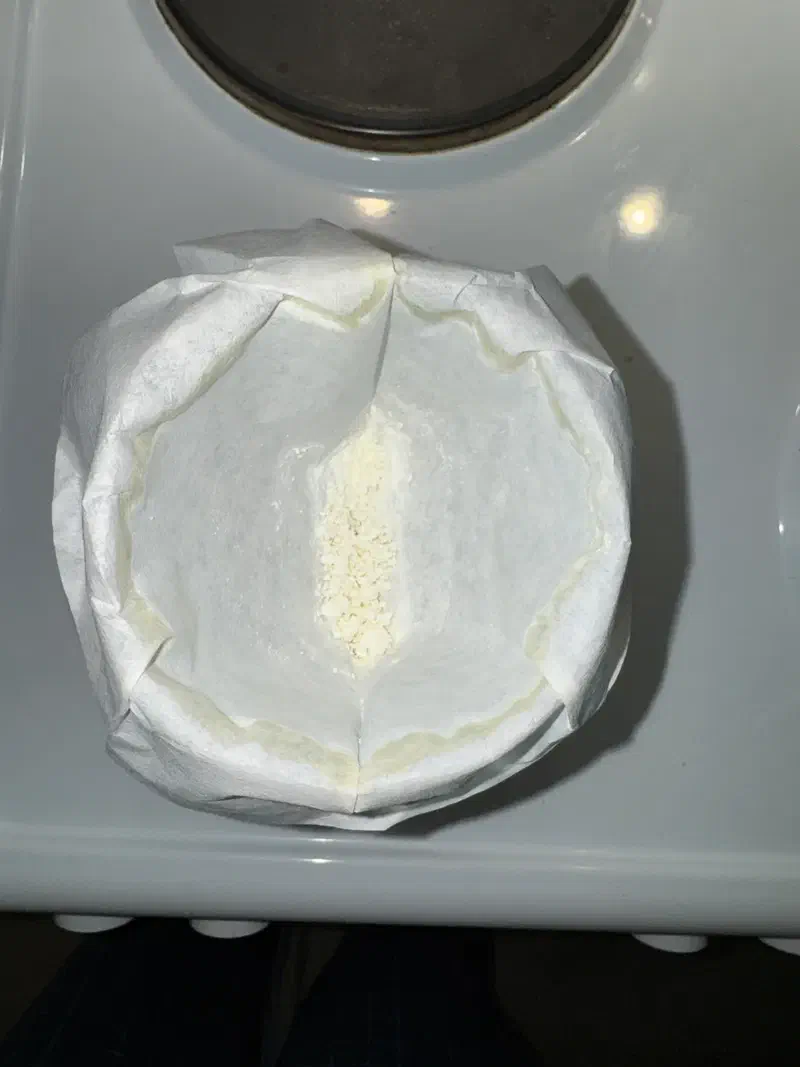
After the first wash. Look at the ring, not the middle. The acetone wicked outward through the paper and dragged every dissolved coloured impurity with it, dumping them at the solvent front. Accidental chromatography. That yellow band was inside your drugs an hour ago.
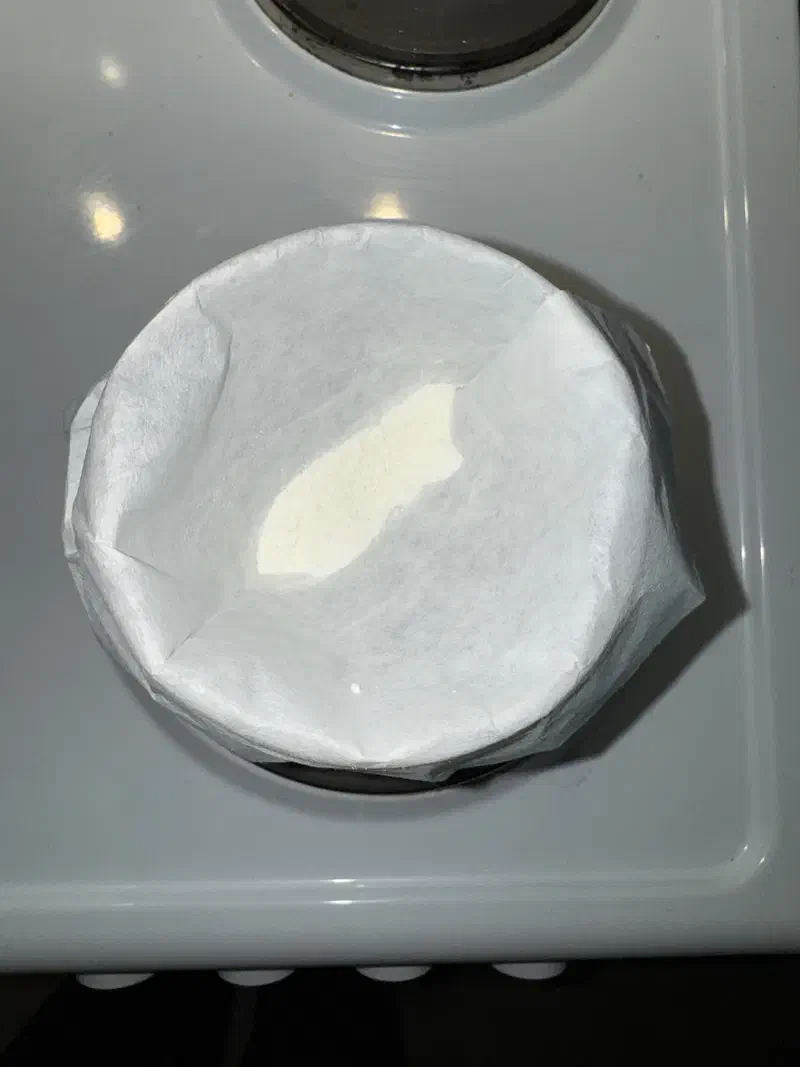
After the third wash. No ring. That’s the visual version of what the scale is telling you: marginal loss has flattened out and there’s nothing coloured left to pull. This is where you stop.
What to look for:
- Yellow and orange staining in the filter and glass: synthesis byproducts. The ring-at-the-edge pattern is the clearest single indicator you get without instruments, and it vanishes in a very obvious way across three washes.
- White crystals forming in the waste glass as the acetone evaporates: usually caffeine, which is very acetone-soluble and recrystallises beautifully. Could be MSM or paracetamol. Don’t assume which. Either way it was in the bag, and now it’s in the bin.
- Photograph every filter. It costs nothing, and the sequence is a far better record of how clean a source runs than your memory of “it looked alright.”
How many washes?#
Three is standard. Your scale decides.
A typical curve:
| Stage | Mass | Loss vs previous |
|---|---|---|
| Raw | 1.900 g | n/a |
| Wash 1 | 1.000 g | −47% |
| Wash 2 | 0.900 g | −10% |
| Wash 3 | 0.870 g | −3% |
| Wash 4 | 0.865 g | <1% |
Stop when marginal loss drops under about 1–2%. Past that you aren’t removing impurities, you’re donating product to filter paper and static electricity.
(Illustrative. Your curve depends entirely on how badly your particular chemist was doing that week. Very clean material might plateau after one wash. Genuinely awful material might still be dropping at four, at which point the thing to reconsider isn’t the technique, it’s the source.)
Losses you can’t avoid#
Even done perfectly, 2–5% per wash disappears into:
- Powder embedded in the filter paper
- Static clinging to the glass and the rod
- Fine dust escaping into the air
- Whatever trace water your acetone was carrying
Normal, and the reason the curve never flattens all the way to zero.
5. Drying, properly, for once#
Residual acetone is a real problem. Solvent-wet powder irritates your airway, tastes appalling, and rather undermines the whole point of washing it.
- Spread it thin on clean glass or ceramic. Surface area does everything here. A thin layer dries in a fraction of the time a heap does.
- Airflow beats heat.
- Use your nose as the endpoint. When you genuinely can’t smell acetone with your face close to the dish, it’s done. Your nose fatigues in about ninety seconds, so leave the room for five minutes and come back for an honest reading.
- Be patient. Large amounts can take a day or more. Acetone gets physically trapped in the crystal mass and leaves on its own schedule.
Heating it (carefully)#
If air-drying is testing your patience, mild warmth helps.
- Target ~40 °C. Don’t go past 50 °C.
- The safe way: warm a clean, empty dish (10–20 seconds in the microwave, or a few minutes in the oven on its lowest setting), take it out, let it cool to merely warm, then spread the powder on it somewhere ventilated.
No microwave, no oven, no hotplate. That’s flammable vapour in a sealed box with an ignition source. Heat only once the bulk of the acetone is gone and the powder is barely damp.
Don’t overdo it. The sulfate is stable at these temperatures, but real heat degrades material, and any freebase content is volatile and will simply leave.
A faint smell after four or five washes is usually trapped solvent, not remaining impurity. The fix is time and surface area, not more washes. You cannot wash acetone out with acetone. Obvious written down, and yet.
6. What you removed and what you definitely didn’t#
Be honest with yourself about what you just achieved.
Gone, or mostly gone#
- Most Leuckart byproducts: the formyl compounds, DPIA, ketone residues, the yellow, the fishy smell
- Production solvents (toluene, ethyl acetate and friends)
- Caffeine
- MSM
- Paracetamol
- Oils and greasy residues
- Some residual acid
Still there#
- Sugars and water-soluble fillers: lactose, glucose, dextrose, mannitol. Acetone doesn’t touch them.
- Creatine and similar inert powders
- Inorganic salts
- Other active drugs that are also acetone-insoluble. This is the one that matters. If your “amphetamine” is partly a substituted cathinone, the wash left it exactly where it was, now at higher concentration, because you removed everything around it.
Edge cases#
- Methamphetamine HCl has real acetone solubility and would be partially removed. So an unexpectedly enormous loss can occasionally mean you washed out an active drug rather than filler. Simon’s reagent separates primary amines (amphetamine) from secondary (methamphetamine) and settles it in thirty seconds.
- Freebase amphetamine is a volatile oil and dissolves in acetone. If your material is oily rather than crystalline, this is the wrong tool.
- Fentanyl and analogues are variably acetone-soluble and cannot be reliably washed out. Contamination of stimulants is rarer than in the opioid supply, but when it happens it kills stimulant users specifically because they have no opioid tolerance. Test strips cost about as much as a coffee. There is no argument against using them.
A washed product is a cleaner product. It is not a known product. You removed poison. You did not establish identity, and you did not establish dose.
7. The water method, and why you probably shouldn’t#
Amphetamine sulfate is very water-soluble (about 1 g in 9 mL at room temperature), so you can run the process in reverse. There’s an important correction to the version that circulates online.
The orientation flips#
Water method: your product is dissolved in the liquid. The solid left in the filter is the waste.
Confuse the two and you’ll confidently bin your drugs and keep the chalk.
What it actually does#
Dissolving and filtering removes water-insoluble material: chalk, talc, dirt, binders, insoluble byproducts. Genuinely useful for that.
The catch nobody mentions#
Evaporating the water gives you back everything that dissolved in it. Lactose, glucose, mannitol, most salts, caffeine, all of it comes right back as the water leaves. You removed the insolubles and achieved nothing else, at considerable effort.
Real recrystallisation, the thing that actually purifies, exploits the gap between hot and cold solubility: minimum volume of hot solvent, filter hot, cool slowly, target crystallises out while impurities stay in solution. That needs:
- Better technique than the acetone wash
- Accepting 20–40% loss into the mother liquor, which genuinely hurts
- Heating a solution of your material, with degradation risk if you overshoot
- Judgement about cooling rate and solvent volume that you will not have on your first attempt
Extra ways to ruin it#
- Water is far harder to remove than acetone. Incompletely dried material grows mould, cakes solid, and turns weight-based dosing into fiction.
- Freebasing accident: add anything basic (baking soda, ammonia) and you convert the sulfate to volatile freebase, which then evaporates. Keep it neutral or slightly acidic.
- Trapped water inflates your mass readings, so your dose arithmetic quietly goes wrong.
Verdict#
The acetone wash gives you 80% of the benefit for 20% of the effort and none of the ways to lose everything. Do that. Treat water recrystallisation as a deliberate project you take on after reading properly about recrystallisation technique, not as a bonus step you tack on at 2 a.m. because you’re feeling thorough.
8. Testing: the part everyone skips#
Washing tells you nothing about what you have. It only tells you what left. Those are different questions, and people conflate them constantly.
Reagents (~€20–40, good for dozens of tests)#
Colorimetric. Tiny scraping on a white ceramic plate, one drop, read the colour against the chart. Do it on white, in good light, and photograph at 30 seconds and 5 minutes, because the colour changes over time and the change is part of the result.
| Reagent | Amphetamine | Why bother |
|---|---|---|
| Marquis | Orange → brown | First-pass screening |
| Mandelin | Green → dark green/blue | Confirmation |
| Simon’s | No reaction | Separates amphetamine from methamphetamine (meth goes blue). Actually important. |
| Liebermann | Orange → brown | Cross-check |
| Froehde | Weak/yellow | Rules out other classes |
| Fentanyl strips | n/a | Different technology entirely. Cheap. Use them regardless. |
Test before and after washing. Comparing the two is informative on its own: if the colour behaves differently afterwards, something was interfering.
What reagents cannot do, spelled out so you don’t over-trust them:
- They indicate a class, not an identity
- They cannot tell you purity or dose. Ever.
- A strong reaction from one component masks everything else in the sample
- Novel compounds give ambiguous colours by design
- Reagents degrade. Store them cold and dark and check the date, or you’re doing chemistry theatre.
Actual lab testing (~€30–60)#
Several harm reduction organisations will run GC-MS or LC-MS on a mailed sample and send back a quantitative breakdown. This is the only method that answers the question you actually have.
- DrugsData.org (US): mail-in, publishes anonymised results
- Energy Control (Spain): accepts international mail-in
- The Loop (UK), Checkit! (Austria), DIMS (Netherlands), Saferparty (Switzerland)
- Norway: check with Rusopplysningen and local harm reduction services, since the practical situation shifts
Do it once per source. It costs money and takes weeks, and it tells you what you’ve been putting in your body for the last year. For €50 that’s the best-value information you’ll buy this decade.
9. Routes, ranked by how fast they ruin you#
The short version#
Oral is the least harmful. Everything else trades intensity now for damage later.
That isn’t moralising, it’s pharmacology. The rate of rise in plasma concentration is what drives the reinforcement signal. Faster onset trains a stronger habit. People who move from oral to insufflation routinely describe losing control within weeks, and it’s a documented pattern, not a personal failing. The drug is doing exactly what it does. You handed it a faster delivery system.
I’ll be blunt, because this is the part I actually care about: route escalation is the single clearest predictor that this is going somewhere bad. Not amount. Route.
Oral#
- Slow onset (30–90 min), long duration, gentle curve
- No tissue damage anywhere
- Easiest to dose accurately, which after section 2 matters more than usual
- Parachuting (weighed dose wrapped in thin tissue paper, swallowed) avoids the taste entirely
- Capsules solve the taste problem permanently and cost nothing
Insufflation#
If you’re going to anyway:
- Never share equipment. Hepatitis C survives on surfaces and in shared straws. Your own straw, only ever yours.
- Clean straw or rolled paper. Not banknotes (filthy), not metal tubes (they cut).
- Grind to the finest powder you can. Crystals abrade mucosa mechanically before the chemistry even starts.
- Alternate nostrils. Yes, really.
- Saline rinse afterwards. Every time. A basic isotonic spray from any pharmacy.
- Unwashed product does substantially more damage, because residual acid is directly caustic to nasal tissue. This is the strongest practical argument for the whole procedure.
- The trajectory: chronic rhinitis → loss of smell → recurring nosebleeds → sinus infections → septal perforation. Not everyone. Enough people.
Injection#
Highest risk by a wide margin: overdose, endocarditis, abscesses, DVT, HIV, hepatitis B and C, vein collapse, permanent damage. If you’re injecting, get to a needle exchange. Most Norwegian municipalities run one, they hand out sterile kit, sharps disposal, wound care and testing, and they are structurally uninterested in reporting you. Never reuse or share anything, including water, filters, and spoons.
Smoking#
Amphetamine sulfate doesn’t vaporise cleanly, it mostly decomposes, so you inhale combustion products instead of drug. Pointless in both directions.
10. Instrumenting yourself#
Here’s where measurement earns its keep. Stimulants damage you through channels you can actually watch. Watch them, and you can intervene before the damage rather than reading about it in your discharge notes.
This is the same argument I make in the perturbation framework: your body is a noisy sensor array, and the numbers are worth more than your impression of how you feel, because your impression is exactly the thing the drug is editing.
Minimum kit#
| Device | Cost | What it catches |
|---|---|---|
| Blood pressure cuff (upper-arm) | €30–60 | Hypertensive crisis, the most common serious acute harm |
| HR monitor (watch or chest strap) | €30+ | Sustained tachycardia, arrhythmia, HRV collapse |
| Thermometer | €10 | Hyperthermia, the mechanism behind most stimulant deaths |
| Pulse oximeter (optional) | €20 | SpO₂ and perfusion |
| Milligram scale | €25–50 | Dose accuracy. Still the most important item here. |
Upper-arm cuffs are meaningfully more accurate than wrist ones. Smartwatch HR is fine for trends and unreliable for absolute values under movement, so use a chest strap if you care about the number.
Numbers and thresholds#
General guidance. Your own baseline matters more than any table, which is the entire argument for taking a sober baseline first.
| Measure | Normal | Concerning | Get help |
|---|---|---|---|
| Systolic BP | <120 | 140–179 | ≥180, or ≥160 with chest pain, severe headache, visual changes, or breathlessness |
| Diastolic BP | <80 | 90–119 | ≥120 |
| Resting HR | 60–100 | 100–130 sustained | >140 sustained at rest, or any irregular rhythm |
| Core temp | 36.5–37.5 °C | 38–39 °C | ≥39 °C, or ≥38 °C with confusion, or if you’ve stopped sweating |
| Sleep | 7–9 h | <5 h for two nights | Hallucinations, paranoia, visual disturbance. That’s sleep deprivation psychosis. Hard stop, no negotiation. |
Call an ambulance#
No jokes in this bit. Don’t wait to see if it passes:
Chest pain, chest pressure, or pain into the jaw or left arm. Severe or sudden-onset headache. Temperature ≥39 °C, or hot skin with no sweating. Seizure. Confusion, disorientation, inability to speak clearly. Weakness or numbness on one side. Persistent vomiting. Fainting or nearly fainting.
Tell them what you took. Paramedics are not police. They cannot treat you correctly without knowing, and treatment for stimulant toxicity is completely different from treatment for opioid toxicity. Guessing wrong is how people die in the back of an ambulance while everybody is being polite about it.
Actually useful practice#
Take a sober baseline BP and HR on a normal day. Then log BP, HR and temp at T+1h, T+3h and T+6h during a session. Three or four sessions in you have your own dose-response curve instead of a stranger’s table. And if your BP runs high even sober, that’s worth dealing with regardless of any of this.
11. Things that will kill you in combination#
Never#
- MAOIs: phenelzine, tranylcypromine, moclobemide, selegiline, and harmala alkaloids (syrian rue, ayahuasca preparations). Fatal hypertensive crisis at ordinary doses. This combination has a body count. There’s no safe amount and no clever way around it.
- Other strong stimulants: cocaine, methylphenidate, other amphetamines, heroic caffeine. The cardiac load stacks, and not linearly.
- Tramadol: both drop the seizure threshold.
Serious caution#
- SSRIs, SNRIs and other serotonergics: serotonin syndrome risk, particularly at higher doses. Amphetamine is more serotonergic at high dose than people assume.
- Alcohol: masks intoxication in both directions, sharply increases cardiac strain, and demolishes your judgement about redosing. Heavily represented in stimulant-related deaths for exactly those reasons.
- Cannabis: reliably amplifies stimulant anxiety and paranoia in the same people who insist it does the opposite.
- Opioids: the stimulant masks respiratory depression until it wears off. Then it doesn’t. Classic fatal mechanism.
- Bupropion: seizure threshold again.
- Sildenafil / tadalafil: additive cardiovascular effects.
Personal risk factors that change the maths#
- Any heart condition, arrhythmia, or structural abnormality
- Hypertension
- History of stroke, or family history of aneurysm
- Hyperthyroidism
- Glaucoma
- History of psychosis, bipolar, or schizophrenia, since stimulants precipitate episodes
- Pregnancy
- Eating disorder history, because appetite suppression interacts very badly here
- CYP2D6 poor metaboliser: amphetamine is partly cleared by CYP2D6, so a standard dose can produce markedly higher and longer exposure. If you’ve had genotyping done, this is one of the few results with immediate practical relevance.
The pH thing nobody mentions#
Amphetamine is a weak base (pKa ≈ 9.9), and that one number controls more of your experience than your dose does.
Renal: in acidic urine the molecule is ionised, doesn’t get reabsorbed, and leaves. In alkaline urine it’s un-ionised, gets reabsorbed, and stays. Measured half-life swings from roughly 7 hours in acidic urine to around 30 hours in alkaline urine. Same dose. Four times the exposure. If you want to see what that does to a repeated-dosing curve, the half-life visualiser makes the shape obvious.
Gastric: same chemistry at the other end. Raise your stomach pH and more of the dose crosses the gut wall, faster and more completely. Anything that reduces stomach acid (PPIs, H2 blockers, antacids, bicarbonate) increases both peak concentration and total absorption. This is documented, printed on prescription amphetamine labelling, and essentially unknown among recreational users.
Which means taking bicarb to settle your stomach mid-session is an underappreciated route to accidental overdose. So is the omeprazole you started because stimulants gave you reflux. Nobody tells you this. Now somebody has.
Full treatment in section 12, including the magnesium trap, which catches the people who read that paragraph and then buy the wrong magnesium salt.
12. Supplements: the ones that do something, and the ones that don’t#
Every drug forum has a supplement stack the length of a shopping list, assembled by somebody with no controls, no blinding, and enormous confidence. Most of it is expensive urine.
A few things have real mechanisms behind them. Here’s the honest split, sorted by how much evidence actually exists. If you want my longer rant about how people misread this kind of evidence, it’s over here.
The pH group: the most important and least known#
Everything here runs on the mechanism in section 11: amphetamine is a weak base, so pH controls both how much gets in and how fast it leaves.
Things that raise stomach pH and therefore increase your dose#
| Substance | Where it hides |
|---|---|
| PPIs: omeprazole, esomeprazole, pantoprazole, lansoprazole | Prescribed for reflux, which stimulant users get constantly |
| H2 blockers: famotidine, cimetidine | Over the counter |
| Antacids: calcium carbonate (Tums), magnesium hydroxide, aluminium hydroxide | Over the counter, taken casually |
| Sodium bicarbonate | Bought as a stomach remedy, or as a “cheap way to potentiate” |
The failure mode is almost poetic: stimulants wreck your stomach → you take a PPI → the PPI increases your absorption → higher peak, more stomach damage, more PPI. You built a loop and nobody warned you it existed.
If you’re on a PPI long-term for an actual medical reason, don’t stop it because of this page. Adjust the dose downward instead, and know that your dose-response curve isn’t other people’s.
The magnesium trap#
Magnesium is genuinely useful for bruxism. But magnesium oxide and magnesium hydroxide are antacids, and magnesium hydroxide is literally milk of magnesia. Take those and you’ve alkalinised your stomach and raised your own dose while trying to protect your teeth.
Use magnesium glycinate, citrate, or malate. Not oxide, not hydroxide. It’s on the label and almost nobody reads it.
I’ve written a whole angry article about magnesium oxide and how badly it absorbs, so I’ll leave it there.
Vitamin C: real mechanism, oversold, and dangerous at the wrong moment#
The folk claim is that vitamin C acidifies your urine and clears amphetamine faster, letting you sleep. The mechanism is real. The execution is shakier than people admit.
What’s true: urinary acidification does substantially accelerate clearance. Ascorbic acid taken with or before a dose also reduces absorption via gastric effects, and some people use that deliberately to blunt a dose they regret.
What’s overstated: ascorbic acid is a fairly weak urinary acidifier. Several studies show minimal effect on urine pH at ordinary supplement doses. The reliable acidifier is ammonium chloride, which was used clinically for amphetamine overdose and has since been largely abandoned, for reasons that matter to you:
If you’ve been dancing, overheating, using heavily, or you have muscle pain and dark urine, you may have rhabdomyolysis: muscle breakdown dumping myoglobin into your bloodstream. Acidic urine makes myoglobin precipitate in your kidneys. You’d be converting a manageable problem into acute kidney injury to get to sleep an hour earlier.
Hot, sore, cramping, dark urine, been at it for hours? Drink water, keep cool, skip the vitamin C, and go to hospital if it doesn’t resolve.
Reasonable use: 500–1000 mg at the end of a normal session, in a normally hydrated, non-overheated person. Not grams. High chronic doses cause GI distress and oxalate kidney stones, and you aren’t going to out-dose the pharmacokinetics anyway.
NAC: the one with actual trials behind it#
N-acetylcysteine is the most interesting thing on this list and the one worth taking seriously.
Mechanism: NAC restores glutamate homeostasis in the nucleus accumbens via the cystine–glutamate antiporter. Chronic stimulant use dysregulates exactly that system, and the dysregulation is closely tied to cue-driven craving and relapse. So the theory isn’t hand-waving, it targets a specific and well-characterised piece of addiction neurobiology.
What the evidence actually says, since you’ll see it oversold everywhere:
- The strongest signal is craving reduction and relapse prevention in people who are already abstinent. That’s where the trials look best.
- The signal in people actively using is weaker. Trials in active cocaine users have been mixed to null.
- Early small trials were promising, several larger replications disappointed. The 2012 adolescent cannabis cessation trial was positive; the 2017 adult replication was not.
- Methamphetamine data is thin: small trials, modest effects.
Verdict: genuinely promising, not a cure, and much better evidenced than anything else in this section. Also cheap and low-risk, which makes the expected value fine even with uncertain efficacy.
Dose: trials typically used 1200 mg twice daily, taken continuously rather than as needed. This isn’t an acute intervention.
Cautions:
- Smells of sulfur. There is no way around this.
- GI upset is common. Take it with food.
- Asthma: rare reports of bronchospasm.
- Interacts with nitroglycerin (hypotension).
- If you’re taking it for the antioxidant angle, note it can blunt some exercise adaptations. Minor, but real.
The blunting problem. NAC does seem to reduce the subjective effects of stimulants for some people. That sounds like a benefit and is sometimes a trap: if the drug does less, people take more. If you start NAC, watch your logs for dose creep. Blunted effect plus unchanged intake is the same cardiovascular load with less to show for it.
Magnesium: thin evidence, near-zero risk, take it anyway#
For bruxism the clinical evidence is honestly weak, mostly anecdotal and mechanistic (NMDA antagonism, muscle relaxation) rather than trial data. But the harm reduction community has used it for decades with consistent subjective reports, it costs nothing, and the downside is loose stools.
Your dentist cannot regrow enamel. That asymmetry alone justifies it.
- Form: glycinate, citrate, or malate. See the magnesium trap above. Glycinate is the best all-rounder: well absorbed, mildly calming, gentle on the gut.
- Dose: 200–400 mg elemental, taken before rather than during.
- Also chew gum. Mechanical, immediate, and it gives your jaw something to do that isn’t your molars.
- Caution: with kidney impairment, talk to a doctor first. Magnesium is one of the few supplements that genuinely accumulates.
Water and food: not supplements, more important than all of them#
You will forget both. Appetite suppression and task absorption see to that. So remove the decision entirely:
- Carry a bottle. Physically, on you. Highest-value tip in this section, costs nothing. You will not go and get water. You will drink water that is already in your hand. Design around the behaviour you’ll actually have, not the one you intend to have.
- ~500 mL per hour of activity. Not more. Excessive plain water plus stimulant-driven ADH effects causes hyponatremia, which has killed people who thought they were being careful.
- Electrolytes if you’re sweating: an oral rehydration sachet or a sports drink. Plain water alone in volume is what creates the sodium problem.
- Set eating alarms before you start. Hunger is not going to turn up and remind you.
- Liquid calories are the workaround. Smoothies, soup, kefir, drinkable yoghurt, protein shakes. Things that need no appetite and no chewing.
- Aim for protein. You’re in a catabolic state and you’ll feel the deficit for days.
The rest: mostly folklore#
- L-tyrosine. Marketed as “replenishing dopamine precursors.” Precursor availability isn’t the rate-limiting step in the state you’re in, and the human evidence for post-stimulant recovery is essentially absent. Harmless, probably useless.
- B-vitamins. Fine. Cheap. No specific evidence for stimulant recovery beyond correcting a real deficiency, though if you’ve been eating badly for months, a real deficiency isn’t unlikely.
- ALA, vitamin E, other antioxidants. Plausible mechanism for neuroprotection, no meaningful human data. Do what you like.
- Zinc. Modulates dopamine transporter function, which sounds relevant and has never been shown to matter practically.
- 5-HTP. Popular, and the one to be careful with: do not combine with SSRIs, MAOIs, or other serotonergics. The MDMA-adjacent advice does not transfer cleanly to amphetamine, and the interaction risk is real.
The sleep problem, which supplements will not solve#
Somewhere around hour twelve you’ll want something to switch your brain off. This is where a lot of people acquire a second drug problem to manage the first one. I did exactly that, so I’m not speculating.
- Benzodiazepines and z-drugs work, and that’s the danger. They work so well for this that the habit forms fast and quietly. Dependence on both stimulants and benzos is a substantially worse position than dependence on one, and benzo withdrawal is the one that can actually kill you.
- Alcohol doesn’t produce real sleep, adds cardiac strain to an already-strained heart, and makes tomorrow worse.
- Melatonin (0.5–3 mg) is low-risk and honestly not very effective against a stimulant. Low doses beat high doses. More is not better with melatonin.
- Sedating antihistamines (promethazine, diphenhydramine) are commonly used. Not benign (anticholinergic load, next-day fog, rebound if used habitually) but lower-risk than the two above.
- The real answer is dosing earlier and dosing less. Nothing in a bottle beats not taking your last dose at 9 p.m.
The honest summary#
If you want a stack that isn’t wishful thinking:
| Supplement | When | Dose | Why |
|---|---|---|---|
| NAC | Daily, ongoing | 1200 mg × 2 | Best-evidenced item here. Craving and relapse. |
| Magnesium glycinate | Before | 200–400 mg | Teeth. Not oxide or hydroxide. |
| Vitamin C | After, if not overheated | 500–1000 mg | Modest clearance help. Skip if rhabdo risk. |
| Electrolytes | During, if sweating | Per sachet | Hyponatremia prevention |
| Water + food | Constantly | Bottle in hand | Beats everything above |
And the anti-list: no PPIs, no H2 blockers, no antacids, no bicarbonate, no magnesium oxide or hydroxide anywhere near a dosing day.
Supplements are unregulated, frequently mislabelled, and occasionally contaminated. The irony of carefully washing your amphetamine and then swallowing an unverified capsule from a company with a stock-photo website should not be lost on you.
13. Session hygiene and the long game#
During#
- Hydrate, but don’t drown yourself. ~500 mL per hour of actual activity. Excessive plain water plus stimulant ADH effects causes hyponatremia, which has killed people who thought they were being careful.
- Eat. You won’t want to. Soup, smoothies, yoghurt, anything that doesn’t require appetite.
- Break from heat and movement. Hyperthermia is the primary killing mechanism, not the drug directly.
- Magnesium glycinate (200–400 mg) for bruxism, plus gum. Form matters, see the magnesium trap above.
- Set your redose cutoff before you start, with an alarm. Decisions made at hour eight are not decisions.
- Don’t drive. Stimulants supply confidence without competence, which is the worst possible combination behind a wheel.
After#
- Sleep is the recovery variable. Not supplements. Not food. Sleep. Plan a free day, because you’ll need it whether you planned it or not.
- Eat properly for 48 hours. You’re in caloric and micronutrient debt.
- Expect 1–3 days of flat mood. That’s dopamine and noradrenaline depletion. It’s predictable, temporary, and not evidence about your life. Don’t quit your job or text anyone during it.
Frequency#
- Two weeks minimum between sessions. Monthly is better.
- Tolerance builds fast, receptor density recovers slowly. Weeks, not days. Your sense of “I feel fine now” is not measuring the thing you think it’s measuring.
- Consecutive days is where dependence forms. Nearly universally. If you’ve gone two days in a row, the pattern is the problem, not the dose.
When it’s becoming a problem#
Not one of these. A cluster:
- Using alone, more often than planned
- The gap between sessions quietly shrinking
- Needing it to work, or to socialise
- Weight loss, dental problems, persistent insomnia
- Hiding it, or lying about the amount
- Failed attempts to cut down
- Route escalating: oral → insufflation → injection
I recognise that list because I lived most of it, and the thing I’d tell my younger self is that the shrinking gap shows up long before anything dramatic does. By the time it’s dramatic you’ve been ignoring the gap for a year.
Asking for help is not the same as quitting forever, whatever you’ve been led to believe. In Norway you can talk to your fastlege without legal consequences, and Rustelefonen (915 08 588) is free, anonymous, and staffed by people whose entire job is to not lecture you. They have heard considerably worse than whatever you’re about to say.
Appendix: logging templates#
The whole argument of this article is that measurement beats vibes. So measure. Spreadsheet, Obsidian, back of an envelope, pick one.
Purification log#
| Field | Value |
|---|---|
| Batch ID / date | |
| Source (anonymised ref) | |
| Starting mass (g) | |
| Colour / smell / texture (raw) | |
| Reagents (raw): Marquis / Mandelin / Simon’s | |
| Fentanyl strip | |
| Acetone grade | |
| Mass after wash 1 | |
| Mass after wash 2 | |
| Mass after wash 3 | |
| Mass after wash 4 | |
| Total recovery (%) | |
| Colour / smell (final) | |
| Reagents (final) | |
| Lab result, if submitted | |
| Dose adjustment factor |
Session log#
| Field | Value |
|---|---|
| Date / start time | |
| Days since last session | |
| Batch ID | |
| Route | |
| Dose 1 (mg) / time | |
| Redose(s) (mg) / time | |
| Total mg | |
| Sober baseline BP / HR | |
| BP / HR / temp at T+1h | |
| BP / HR / temp at T+3h | |
| BP / HR / temp at T+6h | |
| Peak HR | |
| Water (mL) | |
| Food | |
| Sleep that night (h) | |
| Comedown (1–10) | |
| Notes / adverse effects |
Ten sessions in you’ll have a personal dose-response curve, a cardiovascular signature, and the genuinely useful one: an honest frequency record. Memory is extremely accommodating about how often you used last month. A spreadsheet isn’t.
Further reading#
- TripSit: factsheets and combination charts
- PsychonautWiki: pharmacology and dosing, community-maintained, variable quality but usually better than the alternative
- DrugsData.org: public database of lab-tested samples. Browse it. It’s sobering.
- Rusopplysningen (NO): Norwegian harm reduction information
- Rustelefonen (NO): 915 08 588
- EMCDDA: European purity and adulterant trend data
- Forensic literature on amphetamine impurity profiling, if you want the chemistry properly
/Henrik
This is harm reduction information for people who have already made their decision. It isn’t medical advice, it isn’t encouragement, and it isn’t a promise that any of this is safe. Amphetamine carries real cardiovascular, psychiatric and dependency risk that no amount of acetone removes. If you’re struggling, help exists, and it’s considerably less judgemental than you’re expecting.