Designed and printed
Prints
I keep reference material in small containers, and small containers are all the same shape. A drawer of them is a drawer of identical white cylinders with the label facing whichever way you dropped it in. The failure mode there is obvious and it is not “I lost something”. It is picking up the wrong one, in a hurry, because it was the same size and the same colour as the right one.
So I designed a rack. Each container gets one hole, the hole is the size of that container and not the next one up, and the label faces you because there is only one way it fits. Boring problem, boring solution, and it removed a class of mistake I would rather not make twice.
Models
Storage 4
Sample rack, micro
20 wells ⌀ 12.6 mm 93.6 × 61.4 × 32.8 mm
Takes the little vials.
Sample rack, small
6 wells ⌀ 47.1 mm 169.7 × 103.9 × 21.0 mm
Standard 50 ml screw-top jars and aluminium tins.
Sample rack, large
4 wells ⌀ 69.4 mm 163.9 × 148.5 × 32.7 mm
The wide-mouth ones.
Sample rack risers
44.6 × 28.4 × 20.0 mm
Lifts a back row so you can read its labels without pulling the front row out first.
Printing notes
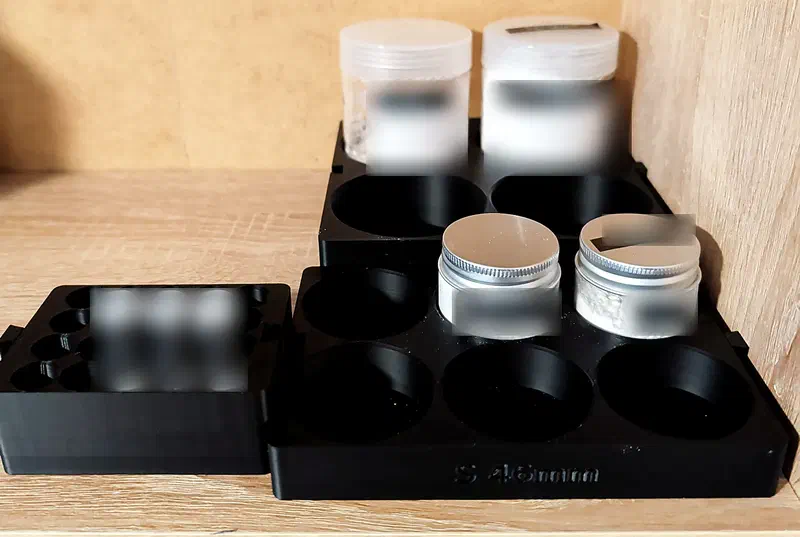
Each rack has its size and nominal container diameter embossed on the front edge
(the one in the photo says S 48mm). The bore is cut slightly under the nominal
figure because printers over-extrude and containers are not perfectly round. If
yours come out tight, scale the model up by a percent or two rather than
reaching for a knife.
The design is modular. The tabs and slots along the edges mean you print as many as you need and click them into one slab, in whatever mix of sizes your containers call for. Nothing is glued, and you can pull a section off and re-arrange it when the collection changes.
The files are plain binary STL, hosted here rather than on a model site. No account, no download counter, no third party learning that you looked at a storage rack from a harm reduction page. They are also small enough that this costs me nothing: 2.7 MB for all four.
Why the photo is blurred
Every label in that picture is smudged out, and that is deliberate. Two reasons, and only one of them is about me.
The first is sourcing. I am not a vendor and I am not a referral link. If the vendor names were legible, the mail I would get about this page would be people asking me where to buy things, and I do not want to be in that chain. What someone else does is their business, but the decision should be theirs and it should not route through me.
The second is that the substance names are not the interesting part. The rack does not care what is in the jar. Showing you a shelf of named compounds turns a storage post into a bragging post, and I would rather it stayed a storage post.
Safety and labelling
Putting things in tidy holes does not make them safe, does not tell you what they are, and does not replace a label with a name, a date, and a source on it. It only makes it harder to grab the wrong container while half awake. That is a real improvement and a small one. Do not let a neat shelf do your thinking for you.
Label everything properly, including the boring stuff. The one you are certain you will recognise later is the one you will not.
/Henrik